Silvery green tones in muted lighting. Sometimes an outing might yield some ideal scenes without much effort. I’ve referred to lost opportunities to capture images because you simply can’t stop to capture the scene - in a line of traffic, no stopping place, can’t get close enough due to private property access or some other reason. If you’re not alert, you might pass a scene and think later you should have made some effort. In that time also conditions can change. This river scene was viewed from the car passing over a bridge. I was determined to get a closer look despite not being able to easily park nearby. Walking onto the narrow bridge was also a challenge with passing cars. I felt it was worth it though. I generally like to take routes that are away from major traffic highways - just so I incur minimal wrath from passing motorists. I’m usually rewarded.
cat or car
I don’t own a cat, or an MG for that matter. She didn’t mind posing though if you were quick enough. I have never worked out why people in the country have such an obsession with broken down vehicles. You can see them hidden in bushes, on blocks laying about the property. This particular place had at least seven of them, none of which were remotely driveable.
escape from...
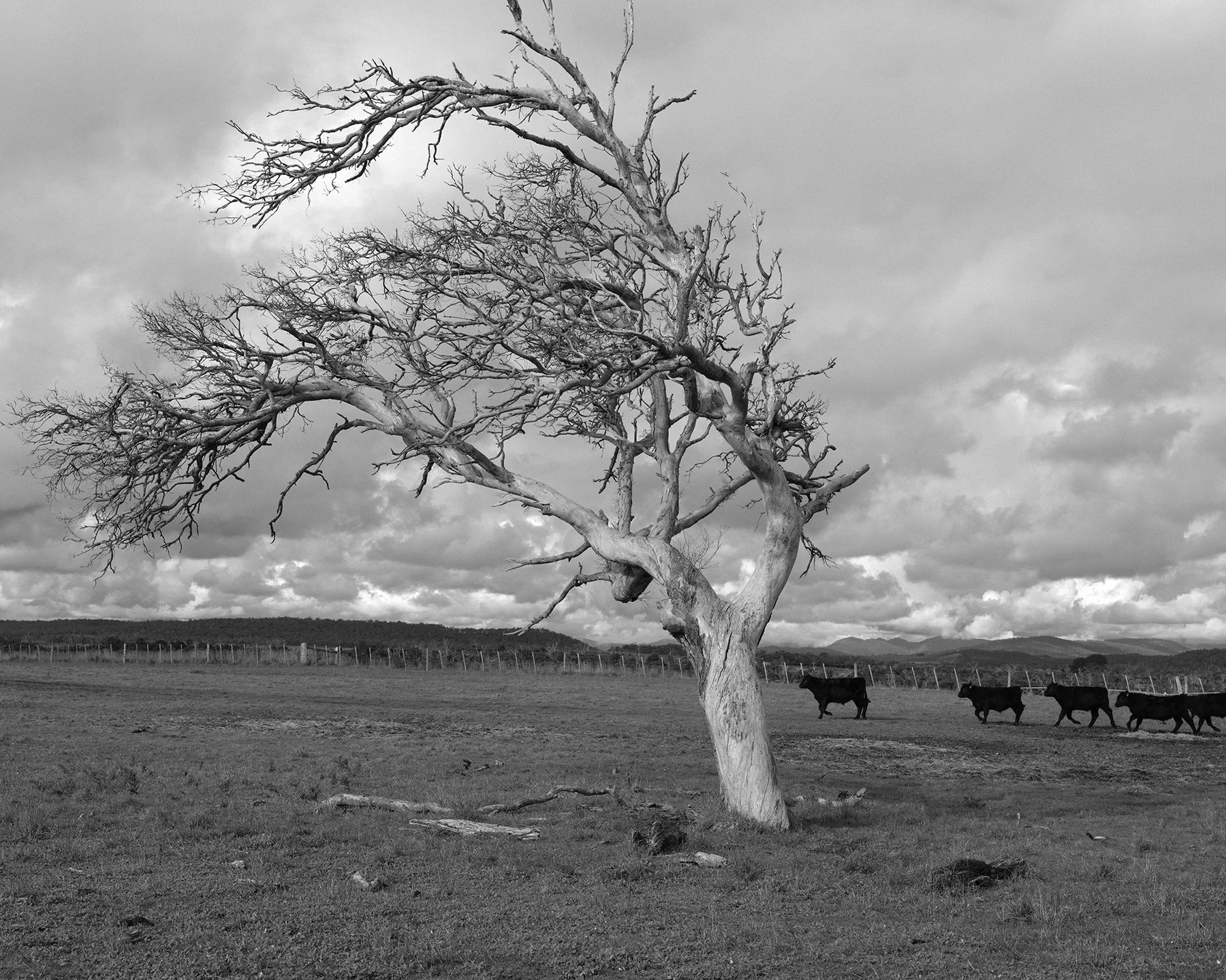
Dead trees have a certain appeal to me. Too much really. I think it stems from the early days of my photography when I found them to be ‘easy targets’. I’m gradually getting over it. Nevertheless here’s one where I waited for a herd of cattle to pass, creating or rather adding to a perceived sense of movement. This is what might pass very loosely for a story. Hence the gratuitous title for this post.
bull and tree
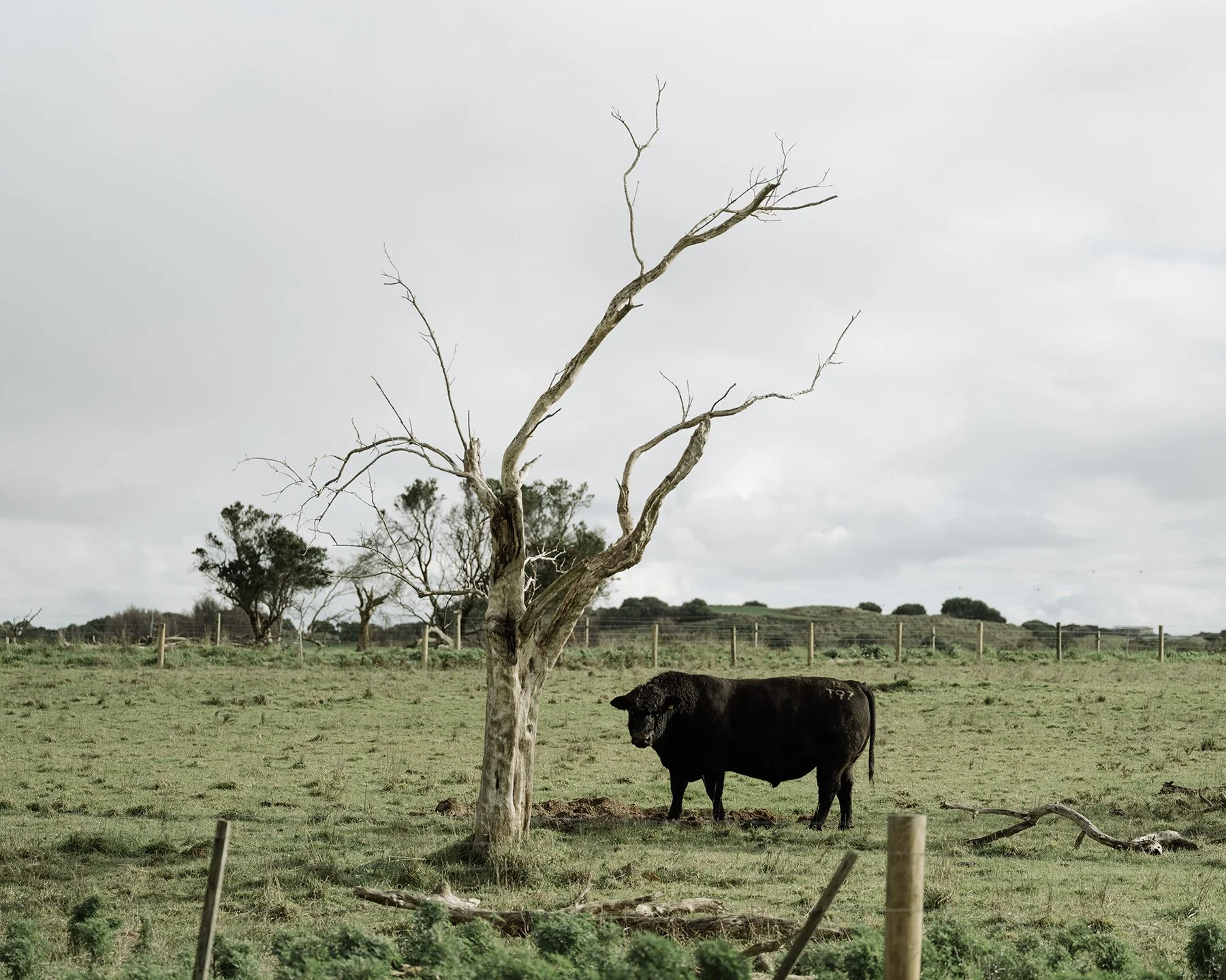
Meandering through the countryside can offer good ops for photos. As mentioned previously I always seek out the longer route to any destination where there is one. I have several of these animal ‘portraits’. The blank canvas of the grey sky background serves these kinds of photos well.
subtle textures
I’m not one to advocate for going to exotic places for photography. It is is useful at times to find a place where people don’t get to so much. Tasmania is an ideal hunting ground for relatively untouched locations where there is not that much evidence of human occupation. Which means you can find beaches where you don’t have to negotiate around the movement of others, footprints in the sand etc. Just be careful of your own.
Out of the woods
Despite all the debate that’s gone on around photography - is it art? One reference that comes up again and again is the fact that some photos don’t look like photos. Or maybe that they have a painterly feel. I do feel drawn to those types of images. Is it because they don’t rely on the cliche of postcard type of images with their bright sunsets and oversaturated nature scenes? Yes, to a large extent. For years I’ve been chasing the colour style that doesn’t represent modern digital photography. I’m fairly happy where I’ve landed with that. Muted tones and subtle lighting reminiscent of some artists from the mid 1800s add to the painterly effect.
When I first began seriously with photography, I noticed that scenes that landscape artists used to paint were not what most photographers that I knew were interested in. Everyday farm scenes or somewhat undramatic landscapes with soft lighting. This is not what camera companies are promoting after all. Fuji and others have thrown out a wider net by providing a variety of colour profiles or styles. Applying an appropriate style to a particular image is another challenge. It may be late in the day, but I would still like to paint some of these images by hand.
flower in the window
Visits to the city these days are few and far between. I bought a 17mm TS lens many years ago to use with the Canon system which I have since sold. Although I used it for work, I would have liked to explore a little more for personal stuff just walking around town. Not to be. Although architectural in nature, the big flower in the window is a big feature of this image. I took it in passing but love the mix of colours and shapes.
A rock wall speaks to other rocks
Norah Head xpan
A couple of extras in the scene just to have some life in the image.
While I'm here...
If I travel anywhere for a job/project, I make a point of looking around the local area. There will always be some random ‘event’ that’s worth shooting. I’m drawn to the coast in any case so then I just need to look around camera in hand. Not a bad way to start your street photography if that’s what you want to try your hand at. Go to places you enjoy visiting anyway. You’ll have an affinity for it so less effort is required.
Toning
I visited an old friend last year. She is a singer and artist. While the shoot turned out well, I liked this portrait of her dog. These dogs (whippets) are a fairly placid and gentle breed. It struck a nice pose which I couldn’t resist. The conversion processing to b&w darkened the background considerably - at the same time bringing out good detail in the rug.
Tendrils
Some time backI had a wander around the veggie patch in search of suitable subject matter. Though this looks somewhat like a pumpkin, i’m not so sure. In any case, the tendrils often create a kind of visual poetry.
Happy mistake
The ageing process is taking it’s toll and yet some happy mistakes are being made. Not sure how I ended up with this 5x4 image. The selection is not close to any of my preferred choices. And, yes the small selection button on the Fuji is a pain to work with. It’s the joystick that gives no joy. I don’t have many complaints about this camera since I suppose you can’t have everything at every pricepoint. Still, this is something they could pay attention to. But if they did, I wouldn’t have this perfectly balanced image to crow about. Do I prefer it to the square format? Probably yes. I’ve never shot film in the medium format world but I like these proportions - a lot. Do I prefer it to 4x3? Possibly. It probably demands more discipline and attention - a need to be more discriminating to create a strong image. That’s what we’re here for though.
wide enough
Crookhaven Rocks
Crookhaven Rocks
The Xpan format is a very versatile one. You get the wide angle look whichever lens you use. Stitching (separate images) is an extra step and a bigger commitment to that style of photography. I don’t have that. Thus I have a rail and nodal rail sitting in a draw taking up space. You can of course trim or crop any file to fit these dimensions but looking at the scene through this view/frame to begin with makes precise capture that much easier. This first image was taken with the Fuji GF 32-64mm, equivalent to about 25 -51mm full frame. The second is a pano taken with the GF 23mm, equivalent to about 18mm full frame. I didn’t think I had much use for this lens. In fact I had it for sale for a short time. Happy I kept it though. I mainly use it for these panorama shots.
Passable feature
iPhone 15 ProMax using pano feature
It may not pass muster as a magazine photo but considering what we had years ago, it’s not too bad. Yes, I can see some bulge in the horizon and the sky colours are inconsistent but…. it handles the direct sun well. And, if you consider the effect of some polarizing filters on wide angle lenses where the sky is very unevenly reflected, it’s not a bad result. Additionally, wide angle lenses don’t cover this much ground. Anyway, not much done in post at all. You just have to make surethe image is balanced and you have enough subject matter to fill the frame.
highlight rolloff
Sometimes the lighting can play just right for an image. I’d finished photographing for the day, as I thought and was driving home. Late afternoon as you know is often when lighting is at it’s best but it’s not always that favourable. For some subjects it’s coming from the wrong angle. I pulled up passing this tree and didn’t bother getting out of car. I took this out of the window. It just happened to be the right angle. I particularly like the light in the background and the way the camera handles it.
all the minor players
Brogers creek, NSW
Recently, a well-known landscape photographer went on a wildlife shoot. His realisation was that even though he wanted to capture an imposing image of his subject - in this case a tiger - he had to capture it with some context that actually enhanced the image. I think this idea extends to landscape photography as well. As much as we like to capture detail and in many cases a more intimate scene, the surroundings often provide interesting textures and detail which enhance the main subject. A lot like bit actors in a movie. Another element that contributes a lot to b&w images is the grey scale range and how it is distributed throughout the image. In this case the backlit area adds some dimension but there are also highlights in the foreground. In landscape photography it doesn’t work that well to crush the blacks unless the detail in shadow areas are a distraction. The milky reflections in the water give a softer, dreamier feel to the image.
Early days
Somewhere near the turn of the century I thought it would be a good idea to adopt digital technology. A friend was using an Agfa camera with the swivel lens (Agfa ephoto 1680). For anyone doing street photography this was in the day, as they say, a game changer. Why? You could roam the streets without anyone realising what you were doing. So, photos were pretty candid for the most part. The design as you know allows for photos to be taken from the hip as it were, just as you can now with a flip screen. Only now, people are very savvy regarding photos taken in this way.
I remember paying around $2100 (AUD) for this camera when it came out. Back then CF cards were mighty pricey too. A 32MB (not GB) card cost me $230! I was pretty happy with the quality of images it put out though. The above photo was taken in Jaipur, India around sunrise. At the time of taking the image below, I also took the same shot with a 35mm film camera. I much preferred the colours on this one.
Finally, this image below. I probably thought I was more invisible than I actually was. Or, maybe he was just curious about my fiddling about with a camera at waist level. In any case it was a step-up from the Agfa which did 1 Mp files while the Nikon did 2 Mp files. Funny Agfa didn’t pursue digital camera production much. They went bankrupt in 2005. (the digital arm at least). I think these images hold up relatively well as digital images albeit smaller size.
38-115mm - 3x optical zoom. f2.8-f4. 2.1Mp. No RAW but tiff format available. ISO 80 / 100 / 160 / 320 (Default 80). Focus modes - Continuous AF mode (when using LCD), single AF, manual focus.
Rocky coastline
I took these images before I started taking methylene blue so I can’t remember where exactly it was. Yes, skies are somewhat different colour - perhaps the filter!
Looking back
A bit of a nostalgic review of some images taken with the Nikon D850 and a wide angle (which now escapes me and which I no longer own). The top image I appreciate for it’s atmospheric qualities and colour. You might notice an unintentional camera movement (double exposure effect) due to a sinking tripod - a happy coincidence I call that. There were several other images taken on the day which displayed some field curvature where houses were included. For that reason, I’m not a fan of super wide angle lenses. I find it too distracting. And too much correction is required to make them acceptable. It’s a little less obvious where nature shots are concerned.